Courtesy of JTA. Photo credit: Orthodox Union
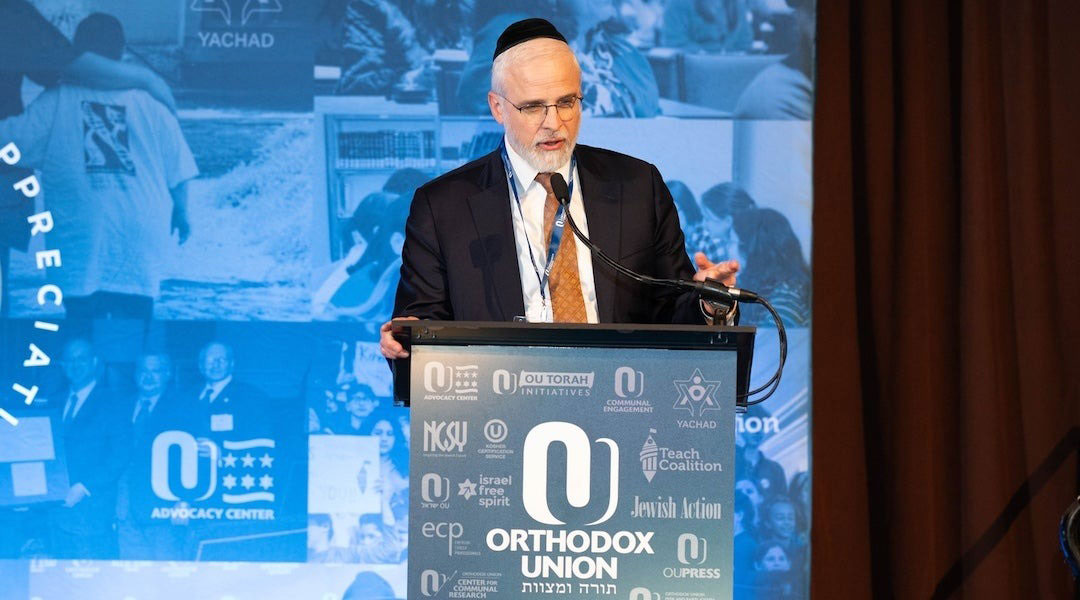
Rabbi Moshe Hauer, executive vice president of the Orthodox Union, speaks at the group’s Biennial gala, held at Cipriani’s in New York City, in February 2025
(JTA) — American Jewry is reeling following the sudden death of Rabbi Moshe Hauer, the executive vice president of the Orthodox Union who was widely known and admired across denominations.
Hauer, the O.U.’s public face since 2020, died of a heart attack at his Baltimore home on Tuesday, the holiday of Shemini Atzeret. He was 60. His death was not announced until Wednesday night, the end of the Simchat Torah holiday.
“Rabbi Hauer was a true talmid chacham, a master teacher and communicator, the voice of Torah to the Orthodox community and the voice of Orthodoxy to the world,” the Orthodox Union said in a statement announcing his death. “He personified what it means to be a Torah Jew and took nothing more seriously than his role of sharing the joy of Jewish life with our community and beyond.”
A levaya, or funeral service, took place Thursday morning at Bnai Jacob Shaarei Zion Congregation, the Orthodox congregation Hauer led for 26 years before taking the O.U. position five years ago.
“You taught us with such clarity, you taught us with such force, with such conviction, you taught us who you want us to be,” said Rabbi Daniel Rose, Hauer’s successor at the synagogue, in a speech he said was short because Hauer’s body and family were due on a flight to Israel for his burial. Pausing to cry, he went on, “I can’t ask you anymore. I think you taught us well enough that we don’t need to ask you.”
Hauer was an exemplar of Modern Orthodoxy’s historical blend of religious and secular expertise. After being ordained at Ner Israel, an Orthodox yeshiva in Baltimore, he earned a master’s degree in engineering from Johns Hopkins University. He was the founding editor of Klal Perspectives, an online journal elevating Orthodox perspectives on contemporary issues.
In 2023, Hauer testified about antisemitism on American college campuses at a hearing of the House Committee on Education and the Workforce. The hearing prompted investigations of several universities for allegedly failing to protect students from antisemitic harassment.
A wide array of Jewish voices mourned Hauer and expressed shock at his sudden death.
In the Jewish Week interview, Hauer pledged to improve “relationships beyond the confines of our community.”
That was also the message of one of his last public statements, shared on Oct. 3. In it he described the upcoming Sukkot holiday as an opportunity for connection among Jews from “ideologically diverse places.”
“Even those who usually live separately must seize opportunities for contact and connection,” he said.
Hauer’s survivors include his mother, Miriam Hauer; his wife, Mindi Hauer; their sons Yissachar, Yehuda Leib and Shalom; daughters Devorah Walfish, Batsheva Neuberger, Chana Schneiweiss and Rachel Hauer, and their spouses and numerous grandchildren.